
Human-written content is eight times more likely to rank at Position 1 on Google than AI-generated content, according to a new Semrush study analyzing 42,000 blog posts.
The research, published in April 2026, found that content classified as human-written carries an 80% probability of appearing at the top spot compared to just 9% for AI-generated content.
These findings arrive at a moment when AI content production has become standard practice across SEO teams, just over two years since ChatGPT brought generative AI into mainstream use.
For many, the question of how well AI-assisted or AI-generated content actually performs in Search has never been more pressing, especially since Google has made clear it does not penalize AI-generated content, provided it meets its quality standards.
Position 1 Remains Dominated by Human-Written Content
Semrush’s most striking finding is the performance gap at the very top of search results. At Position 1, human-written content holds an 80.5% probability of appearing, while AI-generated content registers just 9%.
Importantly, however, the gap narrows considerably from Position 5 onward. For teams benchmarking success against Page 1 visibility broadly, AI content is broadly competitive(and must be heavily led by humans).
The decisive advantage of human-written content is concentrated specifically at the top positions, where search engines appear to reward originality, depth, and subject matter authority most heavily.
“AI can support high-performing content,” noted Ana Camarena, Head of Organic Content Strategy at Semrush, drawing on her team’s own content production experience.
“But content that consistently stands out is still shaped by human input, and that often means trading some speed for better judgment and deeper expertise.”
More Reads: Paid Search Captures More Clicks Than Organic Search on Google
Most SEO Teams Have Already Adopted a Human-Led Model
Despite the rapid expansion of AI tools, the study reveals that most content teams have not handed over production to AI wholesale. 87% of SEO teams report operating workflows that are either fully human-created or heavily human-led, with humans remaining directly involved in production and editing.
The most prevalent model — used by 64% of respondents — is a human-led, AI-assisted approach, where AI supports the process but humans retain editorial control.
Only 23% of teams reported creating content entirely without AI involvement. This suggests that full AI abstention is becoming increasingly rare, even among teams that prioritize human authorship.
What SEO Teams Are Actually Using AI For
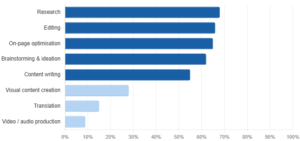
The study makes clear that AI adoption in content teams is not uniform. Its use is heavily concentrated in text-based, process-oriented tasks, and drops sharply when it comes to work requiring specialist creative or technical judgment.
Here is a breakdown of the tasks SEO professionals report using AI for, ranked by adoption rate:
Research, editing, and on-page optimization are the top three use cases, each with adoption rates above 65%.
Brainstorming and ideation support (62%) and general content writing (55%) round out the core tasks where AI has become standard practice.
The contrast with multimedia tasks is striking. Visual content creation is used by just 28% of respondents, translation by 15%, and video or audio production by a mere 9%.
What This Means for SEO and Content Teams
This Semrush study does not make a case against using AI in content production. It makes a case for using it deliberately.
The teams consistently appearing at the top of search are publishing content that demonstrates genuine expertise, incorporates original insight, and reflects a level of editorial judgment that AI alone cannot replicate.
Here is the strategic implication:
Use AI to reduce friction in the early stages of production — research, outlining, and drafting — and invest the time saved into the elements that differentiate high-ranking content.
Expert perspective, proprietary data, and rigorous editorial review remain the variables that matter most where it counts.