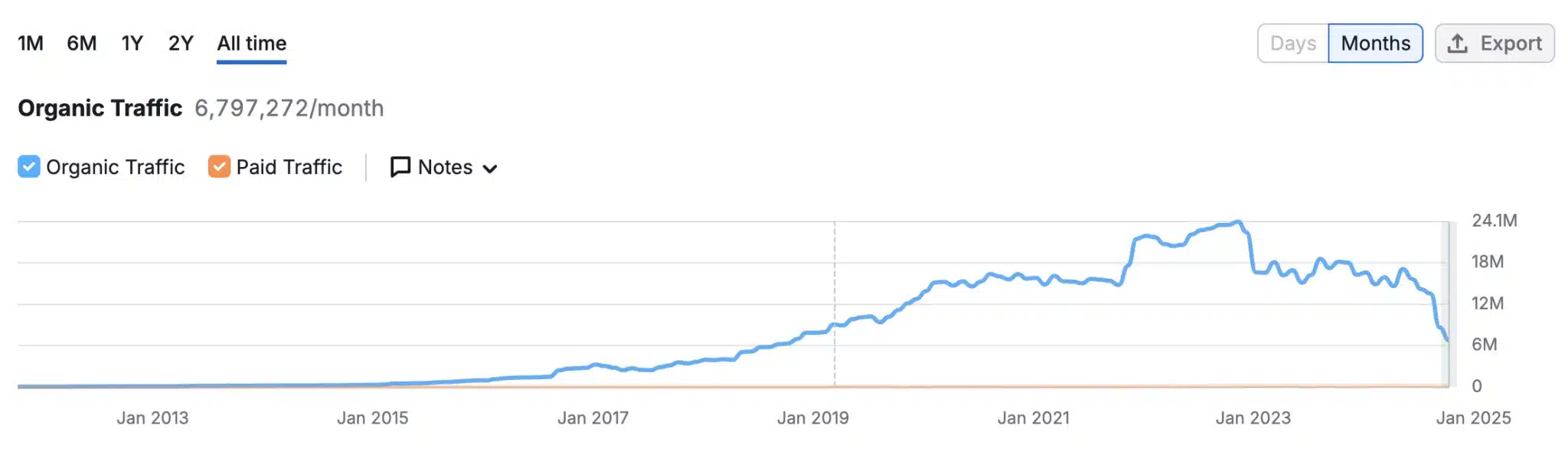
More people are beginning to rely less exclusively on Google search (a key traffic source for publishers and site owners) and more on AI chatbots for certain informational queries. In this vein, Gartner, a prominent technology research firm, had predicted that traditional search engine traffic could decline by up to 25% by 2026. Just in 2025, reports circulated claiming that HubSpot, a major creator of TOFU content covering marketing and business topics, had lost 80% of organic search visits amid the rise of AI-driven tools. Although HubSpot disputed the magnitude of these reports, it acknowledged a significant decline in traffic to its websites.
This shift has left many marketers asking: Is top-of-funnel (TOFU) content still worth creating? In this guide, we’ll explore how TOFU content has evolved, which formats are still relevant, and how to adapt your content strategy to stay visible and valuable in an increasingly AI-powered world.
What is TOFU content?
Top-of-the-funnel (TOFU) content is a digital marketing content designed to attract new audiences by answering broad informational queries and building awareness before pushing any product sale. Typical TOFU content includes how-to blog posts, “what is” and “why” search articles, short-form educational social posts, explainer videos, checklists and beginner guides.
Some Nuances on TOFU Content to keep in Mind
While TOFU content is primarily educational, brands can still showcase their products or services provided it is done subtly and naturally. The key is integration, not promotion. A good example is our blog post, “Top 10 Performance Marketing Agencies in 2026,” which delivers genuine value to readers while positioning our expertise within the industry.
How has AI Disrupted TOFU Content?
The role of TOFU content is rapidly evolving. According to Search Engine Land:
“Organic traffic appears to have declined sharply, dropping from 13.5 million in November to 8.6 million in December, according to Semrush … HubSpot’s blog seems to have taken most of the impact.”
This signals a broader trend AI has fundamentally changed how TOFU content is created and consumed. Because AI tools can now generate acceptable TOFU-style content and instantly answer buyer questions, audiences increasingly bypass traditional awareness-stage content altogether, reducing the need to “search and read” in the way they once did.
Today, most users now directly look up the information they need on ChatGPT or Gemini. Even when they search on Google, AI Overviews often provide a direct answer without users ever clicking on your perfectly optimized blog.
Even when AI tools pull answers from your content, few users would go to your page to check out the full post. This has fundamentally changed the buyer journey. For example, when someone searches for the best marketing agency in the UK, they can now ask ChatGPT or Perplexity and receive a concise list instantly. And if they do use Google, AI Overviews often summarize the answer upfront, allowing users to choose an agency without ever visiting your page. Generating traffic from TOFU content is no longer reliable with this change in motion.
As a result, the way forward in 2026 is no longer just about ranking on search engines, it’s about ensuring your business and content appear and are referenced in AI Overviews and AI-driven search experiences.
How to Win with TOFU Content in this AI Era
Earlier in this article, we explained how AI has reshaped content discovery and consumption. This brings us to the most important question: How do you win with TOFU content in the AI era?
Contrary to popular belief, TOFU content is not dead despite how often that claim has surfaced throughout discussions on AI and content marketing. What has changed is how TOFU content works in an AI-driven ecosystem. We still need expert to explain new concepts that AI data hasn’t been fed with. The simple fact is: The simple fact is this: AI can only provide existing information in response to user queries because it only synthesizes existing information. The gap for novel insights, original perspectives, and first-hand expertise still needs to be filled. That’s where TOFU content remains relevant in 2026 and beyond.
What High-Impact TOFU Content Looks Like in 2026
To stand out in the AI era, TOFU content must evolve from being discoverable to being referencable by both humans and AI’s alike.
Here’s how to do that effectively:
1. Create audience-first content AI cannot replicate
Focus on answering questions from angles AI tools cannot provide such as lived experience, operational insights, failures, and lessons learned. In-depth content grounded in personal or organizational experience gives readers (and AI models) something genuinely new. So, publish content AI cannot generate on its own such as:
- Original survey data
- First-party analytics
- Case studies with real outcomes
- Insights from interviews with industry leaders
2. Create content designed to be cited by AI
AI tools increasingly act as research assistants. Content that is clearly structured, authoritative, and insight-driven is more likely to be cited or recommended creating indirect but valuable traffic and brand visibility. Read our blog on 6 Types of Content Most Likely to Appear in AI Search for some inspo.
Top 3 Content Formats that ‘Resist’ AI
As AI tools become increasingly capable of summarizing and reproducing surface level information, certain content formats remain far more resilient. These formats are difficult for AI to replicate convincingly because they rely on original thinking, proprietary data, and real-world outcomes. Below are the content types that continue to hold strong value in the AI era.
-
Strong Personal Opinion and Point-of-View Content
Content grounded in a clear, confident personal or brand perspective is one of the hardest formats for AI to replace. While AI can summarize prevailing viewpoints, it cannot authentically replicate lived experience, judgment calls, or contrarian thinking shaped by years of practice.
Strong opinion content works because:
- It reflects firsthand insight rather than consensus
- It introduces nuance AI models often smooth out
- It positions the author or brand as a thought leader, not a compiler
Examples include:
- Why “Top 10 Agency” Lists Are Misleading for SMEs in 2026
- What Most AI Marketing Advice Gets Wrong and What Actually Works
- Why We Stopped Chasing TOFU Traffic and Focused on AI Visibility Instead
These pieces are not designed to answer a question conventionally; they are designed to shape how the question is understood, which makes them valuable to both readers and AI systems looking for authoritative perspectives.
2. Original Research (Surveys, First-Party Data, and Statistics)
Original research is one of the most AI-resistant content formats available. AI tools can analyze and summarize data, but they cannot generate credible new datasets. This makes first-party research especially valuable in an ecosystem increasingly driven by AI-generated summaries.
Original research content:
- Serves as a primary source for AI and human researchers
- Attracts citations, backlinks, and AI references
- Establishes credibility and authority in a specific domain
Examples include:
- Industry surveys with original data (e.g., *Marketing Budget Allocation Trends Among UK SMEs in 2026*)
- Internal performance benchmarks
- Aggregated anonymized client insights
- Annual or quarterly trend reports
As AI systems increasingly act as research assistants, content rooted in original data is more likely to be referenced, cited, and surfaced even when users never click through immediately.
3. Case Studies With Real Metrics and Outcomes
Case studies anchored in real numbers are another content format AI struggles to replicate authentically. AI can generate hypothetical scenarios, but it cannot replace verifiable results, real timelines, and documented outcomes.
High-performing case studies include:
- Specific starting challenges
- Clear strategies implemented
- Measurable outcomes (e.g., ROI, conversion lift, cost reduction)
- Context around why certain decisions were made
Examples include:
- How We Increased Organic Conversions by 42% in 6 Months Using an AI-Human SEO Workflow
- Scaling an eCommerce Brand From £80k to £240k in Monthly Revenue With Performance Max
- Reducing CPA by 31% Through AI-Led Creative Testing*
These case studies do more than educate, they build trust. They provide AI systems with concrete, defensible material and give prospective buyers confidence that your insights are grounded in real-world execution.
Conclusion.
TOFU content is not obsolete but the version that relied on keyword repetition, unoriginal explanations, and traffic-first thinking no longer works in an AI-powered world.
As AI tools increasingly mediate discovery at the awareness stage, the role of TOFU content has shifted from driving clicks to shaping visibility, credibility, and influence. Buyers are still learning, comparing, and forming opinions but they are doing so inside AI interfaces long before they ever visit your website.
This means the question for marketers in 2026 is no longer “Should we still create TOFU content?”
It’s “What kind of TOFU content deserves to exist?”
The answer is: create content that AI cannot easily replicate, ignore, or replace. Content rooted in real experience, original data, strong points of view, and measurable outcomes. Content that AI systems reference, cite, and rely on when generating answers because there is no substitute for it. The brands that succeed in 2026 will be those that stop chasing surface-level reach and start building AI-visible authority.
Build thought leadership in your industry with TOFU content that actually performs. Our SEO team has helped brands across finance, fitness, e-commerce, and logistics build digital authority through blogs and social media. Talk to us.