Monitoring your brand’s AI search visibility performance is now a necessary step to ensure you appear where digital audiences search for answers, browse for products, and compare services.
Understanding the right metrics for measuring this visibility is even more important. It allows you to answer the practical business question of whether visibility inside AI answers is supporting discovery, trust, and ultimately revenue potential.
In the following paragraphs, we break down the seven core AI visibility metrics, how each one is measured, and how they can be used to monitor and improve brand presence within AI-generated search environments, such as ChatGPT, Perplexity AI, Claude, Google Overviews and others.
If you’re looking for the best tools or the ones most appropriate for your needs to track AI visibility, explore our previous blog covering the top 15 options.
Top 7 Metrics for Monitoring AI Search Visibility and How to Track Them
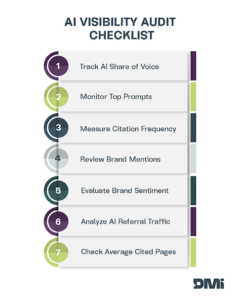
1. AI Share of Voice
AI Share of Voice measures how frequently your brand appears in AI-generated answers compared to competitors within your niche. In industry terms, it refers to your brand’s mentions across AI platforms relative to your competitor’s mentions. This metric is important because AI visibility is competitive. In other words, tracking your own growth is not enough if other brands are moving faster in the same answer space.
To track your share of voice manually, you can type in targeted queries into ChatGPT, Claude AI, Perplexity and other AI platforms. Tracking share of voice manually is similar to how SEOs once checked keyword rankings by manually searching terms on Google to see where their website or page appeared.
For automated tracking, use tools such as Hubspot’s Share of Voice Tool available in its AEO Grader. This tool currently offers AI share of voice score for 3 LLMs: ChatGPT, Perplexity and Gemini.
2. Top Prompts
Top Prompts is another important AI visibility metric that is needed to identify the most common user queries that trigger AI systems to mention or cite your brand and competitors. This metric reveals what AI associates your brand with and whether that aligns with your strategic positioning.
Semrush currently provides one of the most extensive features for tracking top prompts in its AI Visibility Toolkit. This prompt tracking feature, which dashboard is added below, gives you daily updates on changes to your selected prompts in ChatGPT and Google AI Mode only. It is currently available at $199 per month, with a 7-day free trial. The number of prompts you can track depends on your subscription level within the Semrush Toolkit.
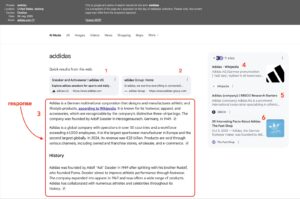
If you want to see how this works in practice, you can refer to the Semrush official guide on using its Prompt Tracking tool and monitoring selected prompts over time.
3. Citation Frequency
Citation frequency measures how often AI systems link to your website or specific pages as supporting sources in generated answers. The practice became more visible when Google introduced link citations within AI Overviews, and other AI platforms. In Microsoft’s AI Performance reports, this is referred to as “page-level citation activity.”
Importantly, citation rates differ across AI engines as study data shows higher citation frequency in Perplexity AI and Google Gemini compared to ChatGPT in standard search-enabled testing. Citation frequency can be tracked through both manual prompt testing and automate
4. Brand Mentions
Brand mentions track how often your brand name appears in AI-generated responses. It does not require a link (unlike citation frequency) or competitor benchmarking (like AI share of voice). It simply tracks inclusion.
For example, if you’re discussing graphic design tools and AI mentions Canva as a commonly used platform for creating visual content, without necessarily linking to its website. That’s brand mentions.
Brand mentions can be monitored through both manual checks and dedicated visibility tracking tools. A basic manual approach involves periodically asking industry-relevant prompts across AI platforms to see whether your brand is included in responses.
However, this method is only useful for small-scale audits. More scalable monitoring typically relies on AI visibility analytics platforms. Ahref’s Radar for example index large sets of prompts and answers to track how often a brand appears, the topics associated with it, and how visibility changes across time.
5 . Brand Sentiment
Brand Sentiment measures whether AI-generated responses describe your brand positively, negatively, or neutrally. It is a must-track metric because AI tone influences trust. Thus, a brand consistently framed positively is more likely to convert users.
Also known as sentiment or intent analysis, Brand sentiment can be measured manually by reviewing AI-generated responses to your brand across selected prompts and categorizing the tone as positive, negative, or neutral based on predefined evaluation criteria.
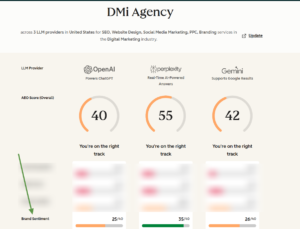
Using the HubSpot AEO grader, DMi Agency achieved a 35/40 brand sentiment score on Perplexity AI, 25/40 on Google Gemini, and 25/30 on responses from OpenAI. The dashboard is shown below.
6. AI Referral Traffic
AI referral traffic measures the number of visitors arriving on your website from ChatGPT, Perplexity, Gemini, and other AI search engines. It is the clearest indicator that AI systems are not only citing your content but driving actual user engagement.
The simplest way to track AI traffic from each platform is through referral reports in WordPress analytics dashboards as shown in the following screenshot.
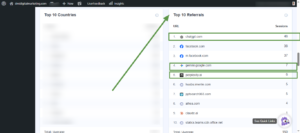
AI referral traffic can also be tracked by configuring custom filters within Google Analytics 4. The approach, as outlined by Semrush, involves using regex-based source filtering to identify traffic originating from major AI engines, organizing referrals into dedicated reporting channels, and reviewing landing pages associated with LLM-generated visits.
Alternatively, you can also measure AI referral traffic using tools Semrush’s AI Traffic dashboard. This tool doesn’t only analyze your site’s AI referral traffic but also compares it with other brands in your industry.
7. Average Cited Pages
Average Cited Pages measures the breadth of your website’s authority by tracking how many unique pages are cited by AI platforms within a given timeframe. This metric is important because wider page-level citation signals stronger knowledge representation across AI-generated answers. If only one or two pages are cited, your AI authority is concentrated and fragile. Broader citation distribution indicates deeper topical strength.
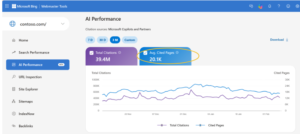
To measure this, you can use the AI Performance reporting tools provided by Microsoft in Bing Webmasters tools. It shows the number of unique pages from your site that appear as sources in AI-generated answers per day over the selected period.
How to Maximize AI Search Visibility Performance
| AI Visibility Metric | Meaning | Ways to Maximize Performance |
|---|---|---|
| AI Share of Voice | Measures your brand’s visibility relative to competitors in AI-generated answers. | 1. Publish authoritative content targeting core industry questions
2. Monitor competitor visibility within shared prompts 3. Expand coverage across high-value topical clusters |
| Top Prompts | Tracks the queries that most frequently trigger AI systems to mention your brand. | 1. Identify priority industry prompts
2. Align content with user intent 3. Update knowledge content as search patterns change |
| Citation Frequency | Measures how often AI platforms link to your website as supporting sources. | 1. Use answer-first content formats
2. Support claims with data and references 3. Improve semantic clarity of key pages |
| Brand Mentions | Tracks how often your brand name appears in AI-generated responses. | 1. Build category-level authority content
2. Invest in PR and external visibility 3. Monitor public information sources |
| Brand Sentiment | Measures whether AI responses describe your brand in positive, neutral, or negative tone. | 1. Maintain accurate public content
2. Address negative narratives 3. Promote credible third-party references |
| AI Referral Traffic | Measures visitors arriving at your website from AI search engines. | 1. Optimize content for citation extraction
2. Track platform-level traffic sources 3. Improve structured content formatting |
| Average Cited Pages | Measures the number of unique pages from your website cited by AI platforms. | 1. Publish content across multiple topics
2. Avoid concentrating citations on few pages 3. Track citation diversity using AI performance tools |
Final Thoughts
Tracking these seven AI visibility metrics – AI share of voice, brand sentiments, brand mentions, citation frequency, average cited pages, AI referral traffic, and top prompts– allows brands to discover revenue potential and act accordingly to maximize opportunities. If you’re seeking to make sense of whether your content is actually driving business value in AI search, let DMi Agency help you discover the most relevant data, develop and implement marketing strategy that matters to your ROI.