
What is Earned Media in the AI Era?
Earned media refers to brand mentions, coverage, and citations from third-party publications such as news outlets, industry blogs, expert interviews, and research reports.
Unlike paid ads or brand-owned content, earned media represents independent validation. It may be free in monetary terms, but it typically requires consistent effort to secure.
The independent validation from earned media matters more than ever.
Two Studies Showing Earned Media Dominates AI Search
Muck Rack Analysis of AI Citations
In its analysis of millions of prompts, Muck Rack found that over 85–95% of AI citations originate from unpaid, third-party editorial content like news coverage and expert commentary. That’s five times more often than company websites. The study further says that these third-party sources are largely big media outlets and industry-based publications.
In other words, the brands appearing most often in AI-generated answers aren’t necessarily the ones with the best SEO, although that matters. They’re the ones that credible publications are talking about.
University of Toronto GEO Study (2025)
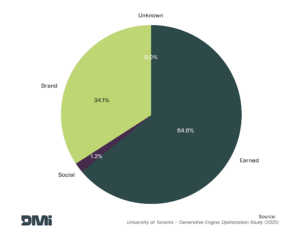
Another study by the University of Toronto (2025) comparing Google and four AI engines—Gemini, Perplexity, ChatGPT, and Claude—found earned media dominates AI search results. One analysis in the banking sector showed earned sources at 64.6%, brand 34.1%, and social 1.2%. Across all sectors studied, earned media remained the dominant source.
So in the AI era, the real question isn’t just “How do I rank?”
It’s: (A) “Who trusts me enough to mention me?” (B) “Which media has the highest citation probability that I can target?“
That’s why earned media is quickly becoming one of the most powerful drivers of visibility in modern search.
Quick Lists of Earned Media To Target
| # | Earned Media Type | How It Shows Up / Why It Matters | Example / Notes |
|---|---|---|---|
| 1 | Editorial Articles | Third-party articles that highlight your brand or insights; boosts credibility | Coverage in Forbes, TechCrunch, The Guardian |
| 2 | Guest Posts | Thought leadership pieces on reputable blogs; builds authority and backlinks | Writing a “Top 5 FinTech Trends” post for an industry blog |
| 3 | Expert Quotes / Interviews | Cited as a subject-matter expert in articles or media | Quoted in a news story on financial planning |
| 4 | Product & Service Reviews | Objective reviews that influence perception and rankings | Reviews on CNET, G2, or Trustpilot |
| 5 | Case Studies / Success Stories | Highlight achievements or results; often referenced by media or peers | Partner or client success story picked up by an industry publication |
| 6 | Research & Whitepapers | Original research cited by others; positions brand as thought leader | University or industry study referenced in media |
| 7 | Press Coverage | News coverage from official announcements or events | Coverage of product launch or corporate milestone |
| 8 | Podcasts | Guest spots or mentions reach niche audiences and build authority | Interviewed on a marketing or finance podcast |
| 9 | Video Features / YouTube Mentions | Featured in videos, reviews, tutorials; drives awareness and credibility | YouTube explainer videos citing your product |
| 10 | Industry Awards | Recognition signals authority and trustworthiness | “Best FinTech Startup” award coverage in media |
| 11 | Forums & Q&A Mentions | Peer-to-peer platforms where brand or expertise is mentioned | Mentions on Quora, Reddit, or Stack Exchange |
| 12 | Ranking Lists / Aggregators | Inclusion in curated “Top X” lists; drives traffic and validation | “Top 10 Banks for Retirement Planning” list picked up by blogs or news sites |
| 13 | Infographics / Visual Content | Shared visuals increase reach and can be referenced by others | Data visualizations or charts shared in industry publications |
| 14 | Social Mentions (Organic) | Mentions by credible accounts increase visibility and trust | Influencer or expert shares your article or report |
Why AI Search Engines Prioritize Earned Media
To understand why earned media is so important for AI search visibility, it helps to understand how AI search works behind the scenes.
Traditional search engines operate by indexing web pages and ranking them based on signals like keywords, backlinks, and domain authority. Users then choose which result to click.
AI search engines work differently. Instead of presenting a list of links, they generate answers directly inside the interface. To do this, AI systems pull information from multiple sources and combine them into a single response.
Because AI tools aim to provide reliable and balanced answers, they often rely on credible third-party sources such as news publications, industry reports, research papers, and expert commentary. These sources frequently contain earned media mentions of brands.
As a result, when a brand is discussed in trusted independent publications, that information becomes more likely to be retrieved, summarized, and cited inside AI-generated answers.
In other words, earned media increases the chances that a brand will appear in AI responses because it places the brand inside sources that AI systems already consider credible.
Let’s break down how this process works in simple terms.
1. AI Understands the Question
AI search engines interpret the intent behind a query rather than just matching keywords.
For example, if someone asks:
“What are the best project management tools?”
The AI doesn’t just search for pages containing those exact words. Instead, it tries to understand that the user wants recommendations, comparisons, and credible evaluations.
That means it will look for sources that already provide expert opinions, reviews, and industry insights.
2. AI Retrieves Trusted Sources
Once AI understands the question, it retrieves information from sources that it considers reliable and authoritative.
These often include:
- Major news outlets
- Industry publications
- Academic research
- Expert commentary
- Data-driven reports
Brand-owned websites are sometimes included, but AI systems frequently prioritize independent third-party sources because they appear more objective.
Research comparing traditional search engines with AI systems found that AI-generated answers rely much more heavily on earned media and third-party publications than brand-controlled content.
3. AI Synthesizes the Information
Next, AI gathers insights from multiple sources and creates a summarized answer.
Instead of showing ten links, it produces one clear response supported by citations.
This is why AI answers often include references like:
- A news article
- An industry report
- A research paper
- A well-known publication
And this is exactly where earned media becomes powerful. If your brand is mentioned inside one of those trusted sources, it becomes eligible to appear inside AI answers.
4. AI Verifies the Information
AI systems rely on techniques like Retrieval-Augmented Generation (RAG), which pulls information from credible sources to verify and support responses.
Because of this, AI tools naturally favor sources that already carry strong credibility signals like established media outlets.
So when a brand appears in respected publications, it increases the chances that AI will recognize, retrieve, and cite that information later.
This process relies on a system often referred to as Generative Engine Optimization (GEO), the practice of optimizing content so that AI systems choose it as a source when generating answers.
Let’s break down how this works in simple terms.
Why This Matters for Brand Visibility
As AI systems depend heavily on credible external sources to generate answers, brands that are frequently mentioned in trusted publications have a structural advantage.
When journalists, researchers, or industry analysts discuss a company in independent reports or articles, that information becomes part of the broader knowledge ecosystem AI systems draw from.
Over time, these third-party references strengthen a brand’s visibility and credibility inside AI-generated responses, making earned media an important component of modern search visibility strategies.
The Benefits of Earned Media in the Age of AI
Now that we understand how AI search works, it becomes clear why earned media plays such an important role.
Let’s look at the biggest advantages.
1. It Builds Trust Signals
AI engines are designed to prioritize trustworthy information.
Content published on a company’s own website is valuable but it’s also self-promotional by nature.
Third-party coverage, on the other hand, provides independent validation. When a respected publication writes about your company, it signals credibility to both humans and AI systems.
That independent endorsement can significantly increase the likelihood that your brand will be cited in AI-generated answers.
2. It Increases the Chances of AI Citations
One of the biggest benefits of earned media is simple: AI tools cite it frequently.
Studies show that AI search engines cite third-party editorial content far more often than brand-owned pages. In fact, some research indicates that AI engines cite earned media up to five times more frequently than brand websites.
This means a single article published in a credible outlet can be referenced repeatedly across different AI responses.
So if your company is mentioned in a well-known publication discussing your industry, that mention could surface in AI answers for dozens or even hundreds of related queries.
3. It Creates Long-Term Visibility
One interesting aspect of AI citations is their longevity.
When a piece of content becomes a trusted source, it can continue influencing AI responses for months or even years.
That means earned media placements aren’t just temporary publicity. They become long-term visibility assets.
A strong feature in a major publication today could still be shaping AI responses tomorrow.
For example, two (2) of DMi Agency’s published articles on Evergreen and Trend-based marketing campaigns have been ranking on Google’s AI overview since last year 2025 giving us a competitive edge for that keyword.
4. It Strengthens Your Brand’s Digital Reputation
AI models don’t just recognize content, they recognize entities.
An entity could be a company, person, product, or concept. AI systems build connections between these entities based on mentions across the internet.
If your brand consistently appears in credible sources, AI models begin associating it with:
- Industry expertise
- Authority
- Thought leadership
- Innovation
Over time, this strengthens your brand’s reputation within the AI knowledge ecosystem.
Read more: Is AI SEO replacing keyword research with entity optimization?
5. It Provides a Competitive Advantage
In traditional SEO, companies could compete through technical optimization alone.
In AI search, credibility matters more.
That means brands investing in public relations, thought leadership, industry research, and media relationships will have a significant advantage over those relying solely on website optimization.
Simply put: authority beats optimization in AI search.
Tips for Getting Referrals from AI Search
So how can brands increase the chances of being referenced in AI-generated answers?
Here are some practical strategies.
1. Target Publications AI Already Trusts
Not all media coverage carries the same weight.
AI search engines frequently cite well-known outlets and authoritative industry publications. Getting featured in these publications increases your chances of appearing in AI answers.
Focus on:
- High-authority industry blogs
- News outlets
- Research organizations
- Professional associations
The more credible the publication, the stronger the signal.
2. Become a Source for Journalists
Journalists constantly need expert insights.
By offering commentary, data, or expert quotes, you can become a reliable source for media stories.
Once journalists cite your expertise, that content becomes part of the information ecosystem AI systems draw from.
3. Publish Original Research
Original research is incredibly valuable in the AI era.
Reports, surveys, and data studies often get cited by journalists and analysts, which creates multiple layers of earned media coverage.
And when AI search engines look for credible statistics or insights, data-driven sources are often the first ones referenced.
4. Build Thought Leadership
Thought leadership is another powerful way to generate earned media.
This can include:
- Guest articles
- Podcast interviews
- Conference presentations
- Industry commentary
These appearances create more mentions across credible platforms, strengthening your brand’s visibility in AI knowledge networks.
5. Structure Content for AI Readability
Even when you earn media coverage, the way information is structured matters.
AI systems favor content that is:
- Clearly organized
- Easy to extract
- Fact-based
- Well cited
Articles that include clear explanations, data points, and structured headings are more likely to be referenced in AI-generated responses.
Final Thoughts
The rise of AI search engines marks a major turning point in how people discover information online.
Traditional SEO focused on ranking pages. AI search focuses on trusting sources.
That shift changes the visibility strategy for brands.
Instead of relying solely on keywords and technical optimization, companies must now invest in credibility and authority.
Earned media delivers exactly that.
It provides:
- Independent validation
- Authoritative citations
- Long-term visibility
- Strong reputation signals
And most importantly, it places your brand inside the sources that AI engines trust when generating answers.
In the coming years, the brands that dominate AI search won’t necessarily be the ones producing the most content. They’ll be the ones most frequently mentioned by credible voices across the internet.